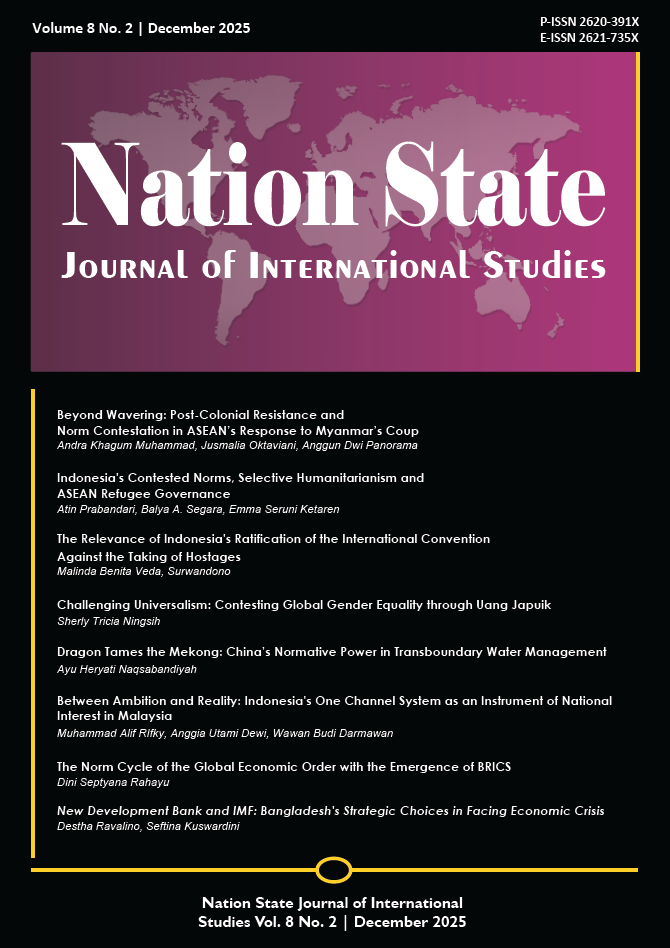
Between Ambition and Reality
Indonesia's One Channel System as an Instrument of National Interest in Malaysia
DOI:
https://doi.org/10.24076/nsjis.v8i2.2145Keywords:
Diplomacy, Governance, Indonesia-Malaysia Relations , Labor Migration , National Interest , One Channel SystemAbstract
This article examines Indonesia's One Channel System (OCS) as a strategic labor migration policy. Grounded in a qualitative content analysis of policy documents and bilateral agreements, the study moves beyond a descriptive account to offer a critical evaluation of the OCS. It utilizes Michael G. Roskin’s theory of National Interest as a foundational framework for understanding the state’s motivations. Still, it enriches this with complementary lenses from the International Relations literature, including migration governance, labor diplomacy, and human security. The findings affirm that the OCS serves as a key instrument of Indonesian statecraft, advancing national security, securing economic interests through remittance formalization, and enhancing international prestige. However, the analysis reveals that significant challenges severelly constrain the policy’s effectiveness. These include a persistent lack of bilateral cooperation from Malaysia, critical on-the-ground implementation gaps, and the unintended risk of state overreach. A fundamental disconnect between the policy’s top-down objectives and the lived realities and agency of migrant workers. The study concludes that while the OCS is a vital assertion of regulatory sovereignty, its success is contingent on bridging the gap between state-centric interests and worker-centric protection. It suggests that future policy must prioritize legally binding bilateral enforcement and address deep-rooted implementation failures.
Downloads
References
Amaritasari, I. (2017). Keamanan Nasional dalam Konteks Isu-isu Global Kontemporer: Sebuah Tinjauan Hubungan Internasional.
Ariyanti, F., & Jannah, L. M. (2020). The Importance of Migrant Workers Protection in Industrial Revolution Era 4.0 (Comparative Study between Indonesia and Philippines). Proceedings of the 3rd International conference on Administrative Science, Policy, and Governance Studies (ICAS-PGS 2019) (p. 172). European Alliance for Innovation.
ASEAN. (2018). Asean Consensus on The Protection and Promotion of The Rights Of Migrant Workers. ASEAN Secretariat.
Betts, A., & Kainz, L. (2017). The history of global migration governance. Refugee Studies Centre, Oxford Department of International Development, University of Oxford.
BP2MI. (2022). Nota Kesepakatan Pemerintah Indonesia dan Malaysia Tentang Penempatan Dan Pelindungan Pekerja Migran Indonesia Sektor Domestik Dl Malaysia.
BP2MI. (2024). Ikut JWG di Malaysia, BP2MI Beri Perhatian Terkait Skill Worker dan Jaminan Pelindungan. Badan Pelindungan Pekerja Migran Indonesia.
Carling, J., & Collins, F. L. (2018). The multiple mobilities of migrants’ money: Remittance sending as a social practice. Journal of Ethnic and Migration Studies.
Chia, S. Yue., & Plummer, M. G. (2015). ASEAN economic cooperation and integration: progress, challenges and future directions. Cambridge University Press.
Dwi, Sihite, V., Sihite, D. V., Rachma, A., Pulungan, N. A., Panjaitan, P. A., Balqis, T. L., & Fatimah, U. (2024). Tantangan Kerjasama Bilateral Indonesia-Malaysia dalam Perspektif Ekonomi: Perlindungan Pekerja Migran Indonesia di Malaysia dari Perdagangan dan Penyelundupan Manusia. Jaksa: Jurnal Kajial Ilmu Hukum dan Politik. 2(1), 227–236. https://doi.org/10.51903/jaksa.v2i1.1528
Fereday, J., Adelaide, N., Australia, S., & Eimear Muir-Cochrane, A. (2006). Demonstrating Rigor Using Thematic Analysis: A Hybrid Approach of Inductive and Deductive Coding and Theme Development. International Journal Qualitative Methode, 5(1), 80-92.
https://doi.org/10.1177/1609406906005001
Ginting, R. S. (2019). Analisis Yuridis Kebijakan Adjusting Imports of Aluminum And Steel Into The United States Berdasarkan Prinsip Hukum Ekonomi Internasional. (Dosertasi doctoral, Universitas Brawijaya).
Haddad, E. (2003). The refugee: The individual between sovereigns. Global Society, 17(3), 297–322.
https://doi.org/10.1080/1360082032000104532
Hsieh, H. F., & Shannon, S. E. (2005). Three approaches to qualitative content analysis. Qualitative Health Research, 15(9), 1277–1288. https://doi.org/10.1177/1049732305276687
Indiarti, M., Liong, Y., Riskasari, R., & Gunawan, Y. I. (2022). Analisis pelaksanaan program pemulihan ekonomi nasional (PEN) sebagai faktor pendorong pertumbuhan ekonomi Indonesia untuk mengatasi dampak ekonomi pandemi COVID-19. Jurnal Manajemen Kewirausahaan, 19(2), 135-146. https://doi.org/10.33370/jmk.v19i1.889
ILO. (2006). Hak-hak pekerja migran: buku pedoman untuk serikat pekerja Indonesia. Organisasi Perburuhan Internasional.
IOM. (2010). Labour Migration from Indonesia. International Organization for Migration.
IOM. (2023). Annual Report For 2023. International Organization for Migration.
IOM. (2024). World Migration Report 2024. United Nations Research Institute for Social Development. International Organization for Migration. https://worldmigrationreport.iom.int/
Ismail, A. (2019). NGO dalam Diplomasi Ekonomi: Implementasi Program Sustainable Development Goals (SDG’s) Poin Pengentasan Ketimpangan Sosial di Indonesia. Insignia Journal of International Relations, 6(1), 1–12.
Leonardo, D. (2024). Comparison of Regulations Concerning Protection of Migrant Workers Between Indonesia and the Philippines. JLPH: Journal of Law Politic and Humanities. 5(1). https://doi.org/10.38035/jlph.v5i1.904
Lipsky, M. (2010). Street-level bureaucracy: Dilemmas of the individual in public services. Russell Sage Foundation.
Longgarini, A. T., Shaafiyah, A. N., & Rahmaningtias, B. M. (2023). Penanganan Pekerja Migran Indonesia Non-Prosedural dalam Perspektif Hukum Keimigrasian. Jurnal Ilmiah Universitas Batanghari Jambi, 23(2), 1474. https://doi.org/10.33087/jiubj.v23i2.3110
Luo, A. (2019, July 18). Content Analysis | Guide, Methods & Examples. Scribbr.
Novia, H., & Djelantik, S. (2024). Indonesia Diplomacy in Protecting the Rights of Indonesian Migrant Domestic Workers in Malaysia (2017-2022). Insignia Journal of International Relations, 11(1), 51–69.
Nye, J. S. (2004). Soft Power and American Foreign Policy. Political Science Quarterly, 119(2), 255–270. https://doi.org/10.2307/20202345
Parreñas, R. S., Silvey, R., Hwang, M. C., & Choi, C. A. (2019). Serial Labor Migration: Precarity and Itinerancy among Filipino and Indonesian Domestic Workers. International Migration Review, 53(4), 1230–1258. https://doi.org/10.1177/0197918318804769
Patton, M. Q. (2015). Qualitative Research & Evaluation Methods. SAGE Publications.
Permadi, B. M. (2022). Standar Ganda Jiran Serumpun. Kompas ID. https://www.kompas.id/baca/opini/2022/08/02/standar-ganda-jiran-serumpun
Roskin, M. G. (1994). National Interest: From Abstraction to Strategy. The US Army War College Quarterly: Parameters, 24(1). https://doi.org/10.55540/0031-1723.1715
Ryanthie, S. (2025). Remitansi Pekerja Migran Indonesia Mencapai Rp 253 Triliun. Tempo. https://www.tempo.co/ekonomi/remitansi-pekerja-migran-indonesia-mencapai-rp-253-triliun-1233888?utm
Saepudin, Raihan Revidy, A., & Aulia Al Mustofa, S. (2024). System Maid Online as Violations of the MoU on Placement and Protection of Indonesian Migrant Workers in the Domestic Sector in Malaysia 2022. Journal Law Review Veteran. 7(2), 174-193. https://doi.org/10.35586/velrev.v7i2.9245
Sarah, N. (2021). Sistem Maid Online: Antara Biaya Murah dan Jaminan Perlindungan. Pusat Sumber Daya Buruh Migran. https://buruhmigran.or.id/2021/12/22/sistem-maid-online-antara-biaya-murah-dan-jaminan-perlindungan/
Setyawati, D. (2013). Comparing Regulations of Placement and Protection of Migrant Workers in Indonesia and the Philippines. ASEAS-Austrian Journal of South-East Asian Studies, 6(2), 264–280. https://doi.org/10.4232/10.ASEAS-6.2-3
Tamba, R. T. (2019). Evaluasi Kebijakan Perlindungan PMI Sektor Informal di Arab Saudi 2011-2018. Jurnal Suara Hukum. 1(2), 199-221. https://doi.org/10.26740/jsh.v1n2.p199-221
Tarom, M. (2025). Peran Penting Aspek Kebijakan Pertahanan Dalam Mencapai Sistem Keamanan Nasional Republik Indonesia.
Thouez, C. (2018). The Global Compact for Migration: A new text for multilateralism.
Uly, Y. A., & Setiawan, S. R. D. (2025). Remitansi Pekerja Migran Indonesia Rp 253,3 Triliun Sepanjang 2024. Kompas Media Nusantara.
Uly, Y. A., & Setiawan, S. R. D. (2025). Remitansi Pekerja Migran Indonesia Rp 253,3 Triliun Sepanjang 2024. Kompas Media Nusantara.
United Nations. (2018). Global Compact for Safe, Orderly And Regular Migration Final Draft.
Wickramasekara, P., & Baruah, N. (2014). Labour Migration for Decent Work in Afghanistan: Issues and Challenges. SSRN Electronic Journal. https://doi.org/10.2139/ssrn.2359158
Wong, D., & Sin, I. Y. (2021). Governing labour migration in ASEAN: The battle for ‘sovereignty’ and the rights of migrant workers. Journal of Contemporary Asia. https://doi.org/10.1080/00472336.2020.1804705
World Bank. (2017). Pekerja Global Indonesia: Antara Peluang & Risiko. www.worldbank.org
Downloads
Published
Issue
Section
License
Copyright (c) 2025 Muhammad Alif RIfky, Anggia Utami Dewi, Wawan Budi Darmawan

This work is licensed under a Creative Commons Attribution-NonCommercial 4.0 International License.